The Platform Merger Trap: Why Stitched-Together AI Always Fails Revenue Teams
Every few years, the revenue technology market rediscovers consolidation.
A new partnership is announced. A platform acquires adjacent capabilities. A narrative takes shape around simplification.
The recent strategic partnership between Clari + Salesloft and 1mind fits squarely into this familiar cycle. Consolidation is presented as progress. Integration is framed as inevitable. The promise is clarity.
For revenue leaders, the emotional appeal is understandable. Modern sales execution has become fragmented. Teams operate across forecasting tools, engagement systems, intelligence providers, customer success platforms, and data warehouses. Each system introduces its own logic. Each handoff introduces friction. In that context, the idea of a single platform that absorbs complexity feels less like a technology decision and more like operational relief.
But experience suggests a more complicated reality.
Mergers rarely remove chaos. They tend to relocate it.
Because behind every partnership announcement is a harder question: what does it actually take to make three platforms, built by three different engineering teams, on three different data models, with three different definitions of a "contact," an "account," and an "opportunity," behave like a single intelligent system?
The answer is: a lot. More than most teams can afford in time, money, or momentum.
When platforms combine, the external story focuses on expanded capability. Internally, however, vendors enter a period defined by reconciliation. Data models must be aligned. Product roadmaps must be reprioritized. Engineering attention shifts from innovation to integration. Customers find themselves navigating new workflows while waiting for promised synergies to materialize.
Revenue execution does not pause during this transition. Quotas do not adjust to accommodate integration cycles. Market conditions continue to evolve. The result is a subtle but consequential mismatch between vendor timelines and business urgency.
Precision becomes harder to maintain at the very moment it is most needed.
The Operational Reality of Stitched Revenue Systems
In the race to simplify the revenue technology landscape, bundling has become the default strategy. Vendors expand into adjacent categories to increase platform footprint. Engagement tools add intelligence. Forecasting systems extend into workflow execution. Customer success platforms move upstream into pipeline visibility. The assumption is straightforward. Owning more workflow should create clarity.
In practice, expanding workflow surface area often amplifies noise rather than improving execution. More dashboards do not produce better decisions. A larger data footprint does not automatically generate context. Without a unifying execution logic, additional tools create parallel narratives about the same deal, account, and quarter.
Revenue teams rarely lack activity data. They struggle because activity signals are disconnected from results. Calls are recorded. Sequences are launched. Accounts are enriched. Yet the most important question remains unresolved. What does this signal mean for win probability, deal timing, and revenue quality?
Forecast accuracy improves when signals are interpreted in sequence rather than in isolation. Pipeline movement gains meaning only when connected to engagement intensity, stakeholder alignment, historical patterns, and customer behavior. The issue is not whether signals sit inside the same interface. The issue is whether they translate into timely guidance that changes execution decisions.
This dynamic reflects a broader shift in how revenue organizations create leverage. Tool ownership was once treated as a proxy for control. Advantage now depends on orchestration discipline. Teams must coordinate actions across marketing, sales, customer success, and finance while maintaining a consistent view of what drives outcomes. Technology delivers value only when it strengthens this alignment.
The limits of partnership-driven stacks become most visible in execution.
Key challenges include:
Data model fragmentation: Every platform defines its own schema, signal taxonomy, and event logic. When systems connect through APIs or middleware, field mappings remain imperfect. Latency accumulates. Duplicate records and conflicting opportunity states emerge. Integration becomes a persistent operational burden rather than a completed project.
Delayed and degraded signal flow: Buyer interactions, deal updates, and engagement insights move across systems through sequential syncs. Each handoff introduces propagation delays. Critical signals often arrive after the window for meaningful intervention has passed, reducing their impact on deal outcomes.
Fragmented memory for AI execution: Effective revenue intelligence requires persistent context across the entire lifecycle. In partnership ecosystems, each platform retains only a partial view. AI operates on incomplete history, producing recommendations that lack credibility and are frequently ignored by frontline teams.
Diffused workflow ownership: When execution breaks at integration seams, accountability is unclear. Vendors evolve independently, releasing updates that can disrupt downstream processes. Internal teams become de facto integration engineers, managing dependencies that do not directly create revenue value.
Distorted model training environments: Machine learning systems trained on asynchronously synced data develop lagging views of pipeline health. Predictions reflect yesterday’s reality rather than current deal conditions. Intelligence becomes observational rather than actionable.
Why Aviso’s Unified GTM Stack Wins Over the Frankenstack
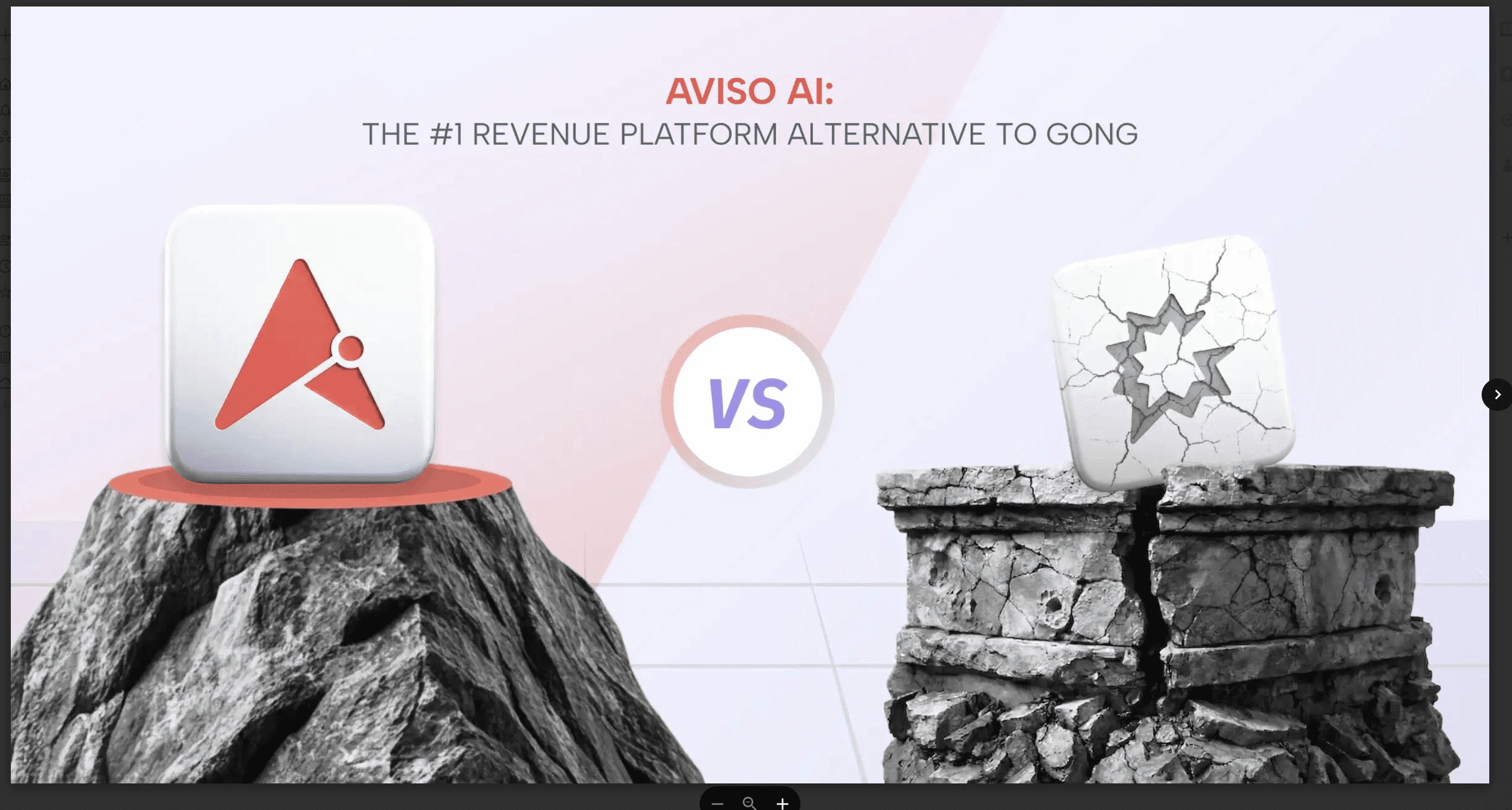
For years, the industry narrative suggested that more "best-of-breed" apps equaled more revenue. Instead, it created an expensive, fragmented mess. Organizations today are drowning in a "Franken-stack" of tools like Outreach, Clari, 6sense, and Gong, each operating in its own silo, requiring constant integration, and forcing reps to toggle between dozens of tabs just to do their jobs.
While competitors attempt to bridge these gaps through partnerships or loose bundling, Aviso is pioneering a fundamentally different path: The No-App Future. Aviso is not a bundle of disconnected tools. It is a single, AI-powered GTM operating system. It replaces the fractured tech stack with a unified system that thinks, learns, and acts as one, providing a true single source of truth for the entire enterprise.
Leading enterprises, including Druva, Nutanix, LogicMonitor, Lenovo, HPE, CDW, BMC, NetApp, and hundreds more, have consolidated their GTM stacks with Aviso, cutting sales technology costs by 50% or more, including reductions in Salesforce and surrounding point tools. More importantly, these teams are now on a clear path to AI-first, agent-driven revenue execution, with Aviso as the foundation.
The Architecture of Aviso’s Unified Revenue System
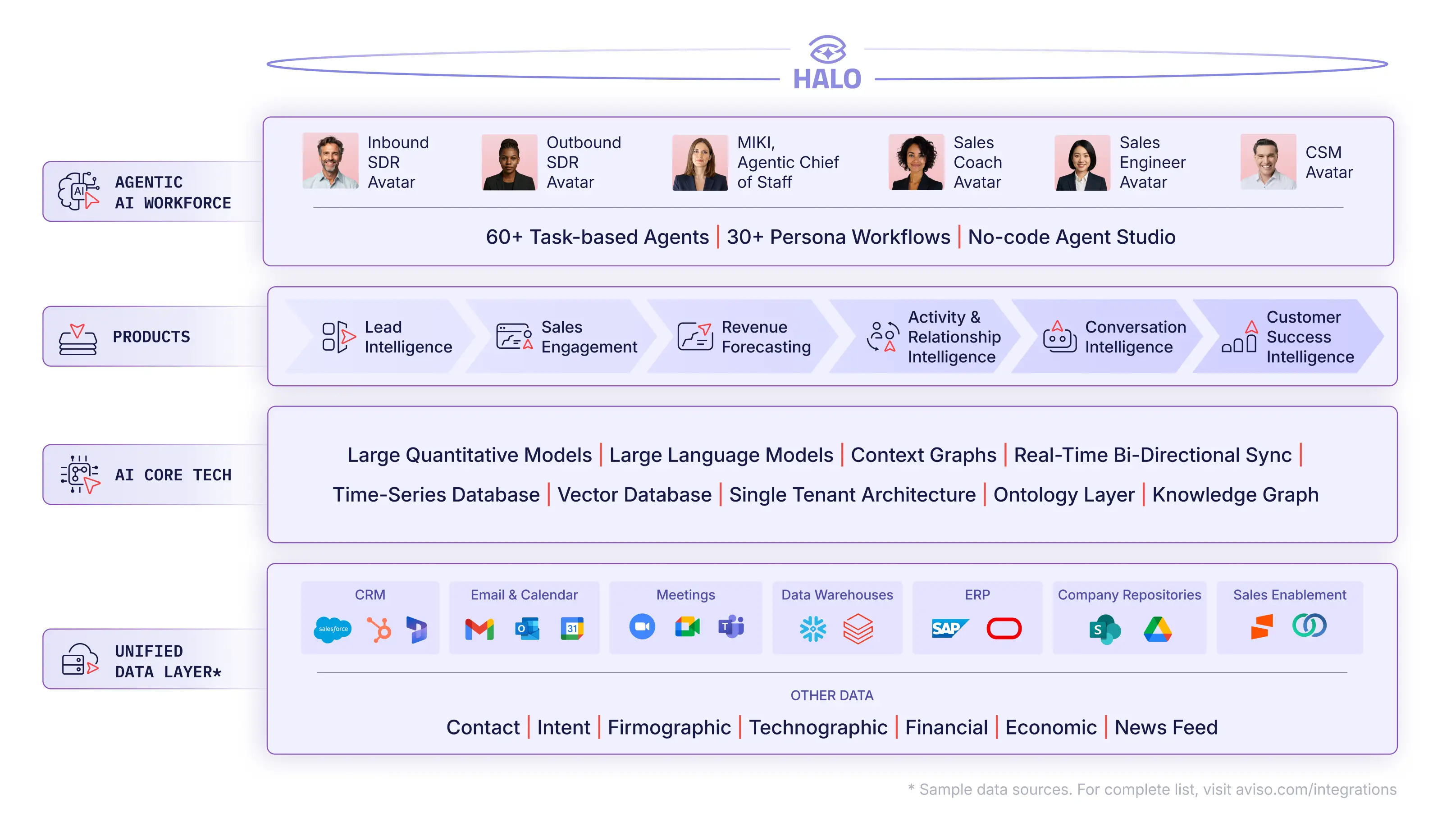
Aviso’s unified stack is organized as a coherent system where each layer builds on the last, enabling organizations to cut technology costs by upto 50% or more while accelerating revenue.
1. System-Agnostic Data Foundation
Aviso connects directly to internal and external systems, such as CRM, ERP, calendars, and intent data, without requiring cumbersome data migration. Data stays where it belongs, but intelligence is unified. This creates a foundation that is not constrained by any single application or CRM.
2. The Execution Backbone
Unlike traditional apps that simply display data, Aviso’s tech layer is designed to reason over it.
Real-Time Data Streaming: Decisions and forecasts reflect the current state of execution, not last week’s update.
Time-Series & Vector Databases: These preserve the history of deal movement and transform unstructured data into semantic meaning.
Knowledge Graph & Ontology: This models the complex relationships between accounts, people, and products, ensuring the AI operates on your company’s specific business definitions.
3. The AI Brain: Beyond Simple Prompts
This is where Aviso diverges from app-centric systems. Most "AI additions" to current stacks are just LLMs (Large Language Models) acting as a UI. What’s been missing in much of the GenAI discussion is a middle layer: predictive reasoning under uncertainty. Aviso’s AI Brain bridges this gap between narration and automation by combining Large Quantitative Models (LQMs) for rigorous forecasting and risk modeling with LLMs.
Large Quantitative Models (LQMs) are purpose-built AI systems that leverage advanced machine learning techniques to process, analyze, and generate insights from numerical and quantitative data. Think of LQMs as the analytical counterpart to LLMs. While LLMs grasp the business context of your questions, it’s the LQMs that provide the rigorous, data-driven backing, transforming raw data into unified, prescriptive actions grounded in your operational reality.
So instead of insights operating in isolation, LQMs connect the dots. For instance, they recognize when a high-commit deal with no recent meetings, weak engagement, and repeated stage slippage signals systemic risk.
4. Integrated Intelligence, Not Point Apps
Aviso collapses entire categories: Lead Intelligence, Sales Engagement, Forecasting, and Conversation Intelligence, into one platform. Because these capabilities share the same memory and context, they work together natively. You no longer need a separate coaching tool, a separate dialer, and a separate forecasting app.
The ultimate goal of Aviso’s No-App Future is to shift the burden of work from humans to the system.
AI Agents: With over 30 agentic workflows and 60+ task-based agents, Aviso handles pipeline hygiene, risk detection, and deal progression autonomously. This is how work gets done without opening an app.
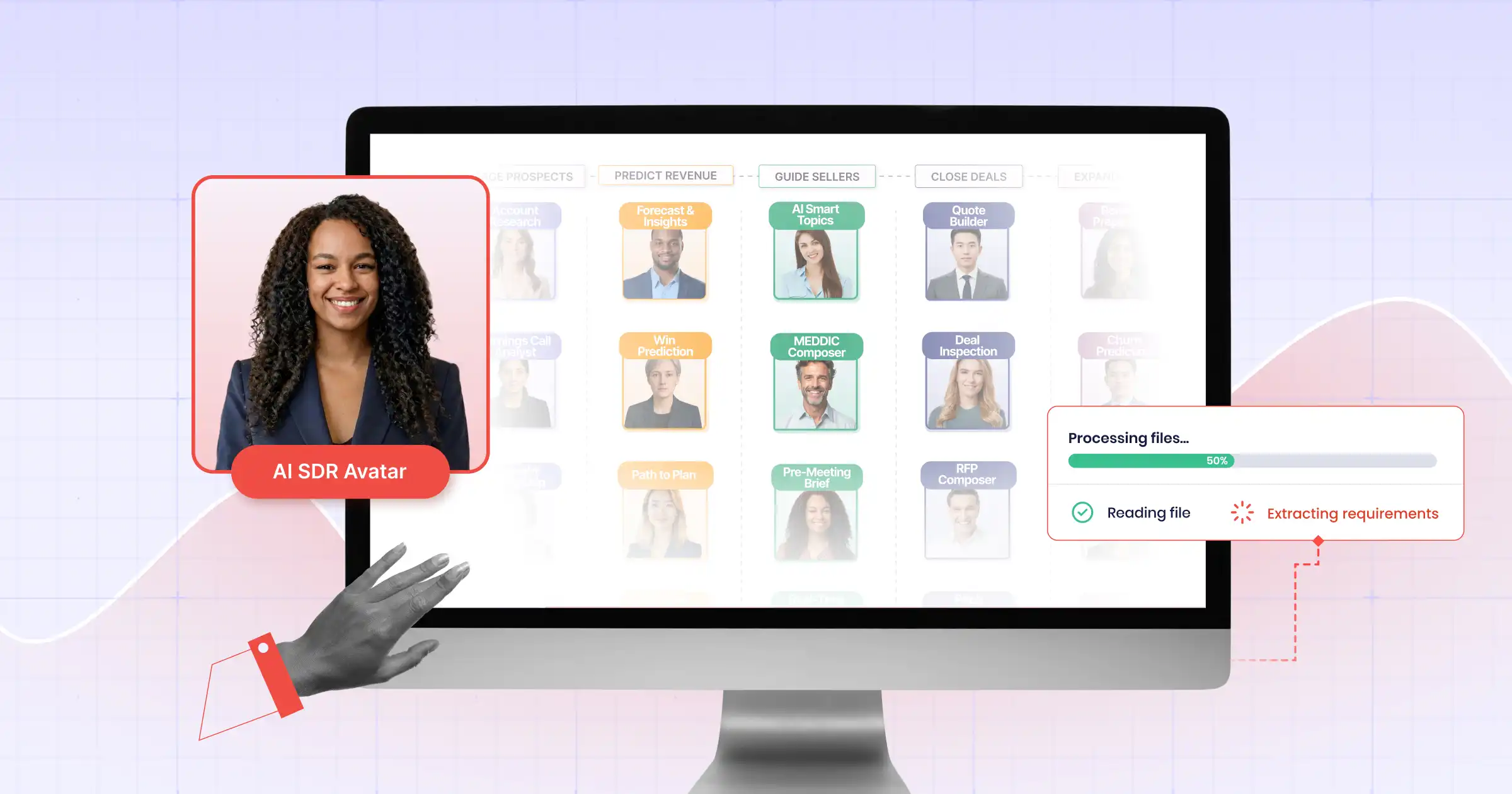
AI Avatars: Purpose-built personas like the Inbound SDR or Sales Coach handle qualification and prospecting, saving reps over 20 hours a week.
Halo: The Single Pane of Glass: Halo acts as the visual interface for the entire stack. It is the first true AI interface built to reduce non-revenue activity, guiding sellers on exactly what to focus on and when to act to stay on plan.
How a Frankenstack Misses Your Hottest Buyer, and Aviso Does Not
The Problem in a Stitched Stack: In a typical tool-sprawl environment, capturing website intent requires at a minimum three separate tools: a visitor de-anonymization tool like Clearbit or Warmly, a CRM for enrichment, and a sales engagement platform to trigger sequences. Each has its own data model, its own definition of a lead, and its own sync cadence.
The result maps directly to the five failure modes outlined in the Platform Merger Trap. By the time a hot visitor is de-anonymized in Tool A, enriched in Tool B, scored in Tool C, and a sequence is triggered in Tool D, the window of peak intent has already closed. The signal arrived. The action was too late.
The problem with stitched stacks is not that signals are missing. It is that they arrive after the moment to act has passed.
Aviso’s Unified Revenue Engine: One Platform. Complete Revenue Execution.
Revenue teams today are stuck stitching together a fragmented stack of point solutions. One tool for intent, another for outreach, a separate system for forecasting, and yet another for deal inspection. The result is a Frankenstein stack that slows teams down, creates data silos, and weakens execution.
Aviso replaces this with a single, unified revenue execution platform that connects every stage of the revenue lifecycle into one continuous flow. No switching tools. No broken context. Just one pane of glass from first touch to expansion.
1. Identify High-Intent Website Visitors
Every revenue journey starts with a signal. Aviso’s Website Visitor Intelligence identifies anonymous and known visitors, enriches them with firmographic and behavioral data, and surfaces high-intent accounts in real time. Instead of waiting for form fills, your team knows exactly who is showing buying intent and why.
2. Engage Instantly with AI SDR
Once intent is detected, Aviso activates AI SDR agents that engage prospects with personalized outreach across channels. These agents qualify leads, respond in real time, and book meetings automatically. No lag, no missed opportunities, and no dependency on manual follow-ups.
3. Predict Revenue with Confidence
As pipeline builds, Aviso continuously analyzes deal signals, buyer engagement, and historical patterns to generate accurate forecasts. Leaders get real-time visibility into pipeline health and risk without relying on manual rollups or guesswork.
4. Guide Sellers to Win
Aviso acts as a co-pilot for sellers, providing deal-level guidance on next best actions, stakeholder engagement, and risk mitigation. Instead of reactive deal reviews, sellers get proactive recommendations that improve win rates and shorten cycles.
5. Accelerate Deals in Motion
When deals stall, Aviso identifies friction points and triggers actions to move them forward. Whether it is re-engaging stakeholders, refining messaging, or surfacing hidden risks, the platform ensures momentum is never lost.
6. Close with Precision
By aligning buyer signals, seller actions, and deal intelligence in one place, Aviso helps teams close deals faster and with higher confidence. Every interaction is informed, every step is intentional.
7. Expand and Retain Revenue
The journey does not end at close. Aviso continues to monitor customer health, product usage, and engagement signals to identify upsell and cross-sell opportunities while proactively reducing churn risk. Revenue growth becomes continuous, not episodic.
The Future of Revenue Is Not More Tools
"Applications as we know it are not going to exist in five years. The phones you have are edge devices, AI is going to mediate the interface and give you the ability to have your own personal agent that transcends both your personal life as well as your work life."
— Trevor Rodrigues-Templar, President & CEO of Aviso
What Trevor describes is not a distant vision. It is a fundamental shift already underway, and revenue teams are feeling it first. The move from applications to AI-mediated execution changes the unit of work. It is no longer about navigating multiple tools. It is about agents operating on shared context, executing workflows end to end. But this future cannot be built on fragmented systems.
When platforms merge, customers do not inherit a finished system. They enter a period of adjustment. Interfaces evolve. Terminology changes. Data definitions are reinterpreted. Training investments must be renewed. Even minor disruptions can ripple through pipeline momentum.
This is the gap between where the industry is heading and how most systems are built today.
Transitions of this kind are rarely visible in launch announcements, but they are deeply felt inside revenue organizations. Forecast confidence can erode. Adoption patterns can stall. Decision cycles can lengthen.
The risk is not that consolidation fails to deliver value over time. It often does. The risk is that during the journey toward that future state, execution clarity becomes harder to sustain. And without execution clarity, AI cannot operate effectively.
In a unified platform, the seams do not exist. The data model is one. The memory is shared. The agents have complete context. The workflows run on a single codebase. When something needs to update, it updates everywhere, immediately, without a sync job catching up overnight.
This is what makes the shift from tools to agents real, not theoretical.
Real business problems do not live inside a single tool. But they also do not get solved by stitching three tools together and hoping the connectors hold. They get solved by a platform that owns the entire workflow, from the first buyer signal to the closed-won to the renewal, and extends it with agents that have the context to execute autonomously.
That is what Aviso is. Not a partnership. A platform.
Join Lenovo, NetApp, BMC, LogicMonitor, and 450+ enterprise revenue teams running on Aviso.